



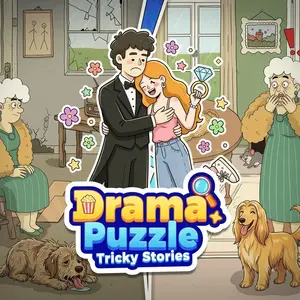
Drama Puzzle Tricky Stories
Drama puzzle tricky stories combine a tense situation with a mystery you can solve. Each one gives you a few clues, but something may not be as it first appears. Read carefully, make your guess, and then check the answer.
These short puzzles are for readers who enjoy brain teasers, clever twists, and story-based riddles. Try to solve each one before scrolling to its explanation.
1. The missing necklace
At a family dinner, Maya says her gold necklace has vanished. Three people were near her coat, where she left it.
Leo says, “I never went near the coat.”
Nina says, “I saw Leo by the coat, but he didn’t take anything.”
Omar says, “Nina was alone in the hallway.”
Maya checks the hallway camera. It shows Leo and Nina standing together beside the coat. One person’s statement must be false. Who is the best suspect?
Answer: Leo. He claimed he never went near the coat, but the camera shows him there. That makes his statement false. The footage does not prove he stole the necklace, but it makes his claim suspicious.
2. The locked classroom
A teacher finds the classroom door locked after lunch. Inside, a book has fallen from a high shelf. The windows are shut, and nobody is in the room.
A student says, “The wind must have knocked it down.”
What detail makes that explanation unlikely?
Answer: The windows are shut. If no one entered and there is no other sign of a draft, the wind is a weak explanation. The puzzle does not tell us exactly what happened; it asks us to notice that the student’s guess is not supported by the clues.
3. The late bus
Three friends arrive late to a film.
Alex says, “The bus was late.”
Bea says, “The bus arrived on time, but we missed it.”
Chris says, “Alex and Bea are both wrong. We walked here.”
A ticket seller says the bus pulled up just as the friends ran into the lobby, still out of breath. Which explanation best fits what the seller saw?
Answer: They probably took the bus and rushed from the stop. Alex or Bea could be right about why they were late, but the clues don’t show whether the bus itself was delayed. Chris’s claim that they walked is harder to square with the bus arriving as they ran in.
4. The silent phone
During a storm, a family loses power. The next morning, Sam says, “I didn’t hear the weather alert because my phone was dead.”
His sister replies, “That can’t be the whole reason. You were charging your phone when the power went out.”
What should Sam check before deciding the phone ran out of power?
Answer: Whether the phone had battery left and whether alerts were turned on. Being plugged in when the power stopped does not tell us how much charge it had. The sister’s clue challenges Sam’s explanation but does not prove it false.
5. The muddy footprints
A shop owner discovers muddy footprints leading from the front door to a display case. The back door is clean.
A worker says, “The thief must have come in through the front.”
What is the catch?
Answer: The footprints only show that someone walked from the front door to the case. They do not prove the person was the thief or that they entered from outside. Someone already in the shop could have made them, or the tracks could have been left at another time.
How to solve dramatic story puzzles
A good story puzzle rewards careful reading more than fast guessing. Use these simple steps:
- Separate facts from claims. A character’s explanation is not automatically true.
- Look for contradictions. Compare what each person says with the other clues.
- Ask what the clues actually prove. A suspicious detail may raise a question without settling the whole mystery.
- Watch for assumptions. A locked door, a missing object, or a dramatic statement may distract from a smaller clue.
- Be open to more than one explanation. If the story does not give enough evidence, say so instead of treating a guess as certain.
The best drama puzzle tricky stories leave you with a satisfying “aha” moment—but the solution should still follow from the clues. Try changing one detail or adding a new clue to create a mystery of your own.
FAQs
What is a drama puzzle story?
It is a short story built around a problem, mystery, or surprising detail. Readers use clues in the story to work out what may have happened.
How do I solve a tricky story puzzle?
Read the story twice, list the facts, and compare them with what each character says. Avoid treating an assumption as proof.
Are these puzzles meant to have only one answer?
Not always. Some puzzles provide enough clues for one clear answer; others are open-ended and support several reasonable explanations.